
In 2020, a small family-run travel blog experienced something that most new websites would dream of.
Within just two months of launching, TheSmokies.com reached 229,000 unique visitors.
But there was a problem.
Almost all of that traffic — around 96% — was coming from social media.
The founders quickly realized that a business built almost entirely on social traffic could disappear as quickly as it had grown.
So they changed direction.
They started learning SEO, fixing their website, researching keywords, improving old content and building backlinks.
The result?
Organic search eventually became the site’s biggest traffic source, and the business generated more than $200,000 in annual revenue in 2021.
Here’s what makes the story interesting.
The Website Wasn’t Built by an SEO Expert
TheSmokies.com was launched in April 2020 by Morgan Overholt, her sister Alaina O’Neal and her husband James Overholt.
The idea was simple: create a website about the Great Smoky Mountains and help visitors find information about attractions, restaurants, events and things to do in the area.
Morgan had a background in graphic design and publishing. Alaina was a writer and designer, while James brought software development and data experience to the business.
But SEO wasn’t their original specialty.
In fact, Morgan told Semrush that she started with essentially no SEO knowledge and learned along the way.
That makes the story particularly interesting for smaller websites.
The founders weren’t starting with an established media company or a huge SEO department.
They were learning while building.
The First Traffic Explosion Came From Facebook

The website’s early growth wasn’t actually an SEO success story.
During the early months of the COVID-19 pandemic, the team created content around local travel, closures, reopenings and regional information.
They promoted that content heavily through Facebook.
It worked.
According to Semrush’s case study, TheSmokies.com reached 229,000 unique visits in just two months after launching.
But approximately 96% of that traffic came from social media.
That was the warning sign.
Social traffic had helped them grow quickly, but they didn’t control the platform or its algorithm.
The founders realized they needed another source of traffic that could be more sustainable.
That’s when SEO became a priority.
They Started With the Basics
In June 2020, Morgan purchased a Semrush subscription and began learning how SEO worked.
The team didn’t rely on one magical tactic.
Instead, they worked through a series of improvements.
1. They cleaned up the backlink profile
The first step was understanding the website’s existing backlink profile and dealing with problematic links.
The lesson here is important: getting links isn’t the only part of link building.
Understanding what is already pointing to your website matters too.
2. They fixed technical problems
The team also worked on technical SEO issues that could prevent the site from performing as well as it could in search.
Technical SEO isn’t necessarily exciting.
But a great content strategy can struggle if a website has fundamental technical problems.
3. They looked at competitors
One of the most useful parts of the strategy was finding keyword gaps.
Instead of simply publishing whatever came to mind, the team examined what competitors were ranking for and looked for opportunities.
This helped them understand what people were actually searching for.
4. They developed a keyword strategy
The team began making more deliberate decisions about the topics they covered.
Rather than treating every article as an isolated piece of content, they started thinking more strategically about search demand and the topics visitors wanted information about.
5. They improved old content
This is one of the parts of the story I find especially valuable.
SEO wasn’t just about publishing new articles.
The team also went back to existing content and rewrote or improved pages.
That’s something many websites overlook.
A page that already has some visibility can sometimes represent a much better optimization opportunity than starting from zero.
6. They monitored rankings
The team tracked changes in search positions and used the data to understand what was working.
That created a feedback loop:
Publish → measure → improve → monitor → repeat.
7. They built a stronger backlink profile
Once the site’s content and SEO foundations improved, the team continued working on earning links and collaborating with high-authority websites.
Semrush specifically highlights unique content, infographics, statistics, studies and collaborations as part of the site’s approach to earning links.
The Traffic Mix Eventually Changed
This is where the story becomes particularly interesting.
The website’s initial growth had been dominated by social media.
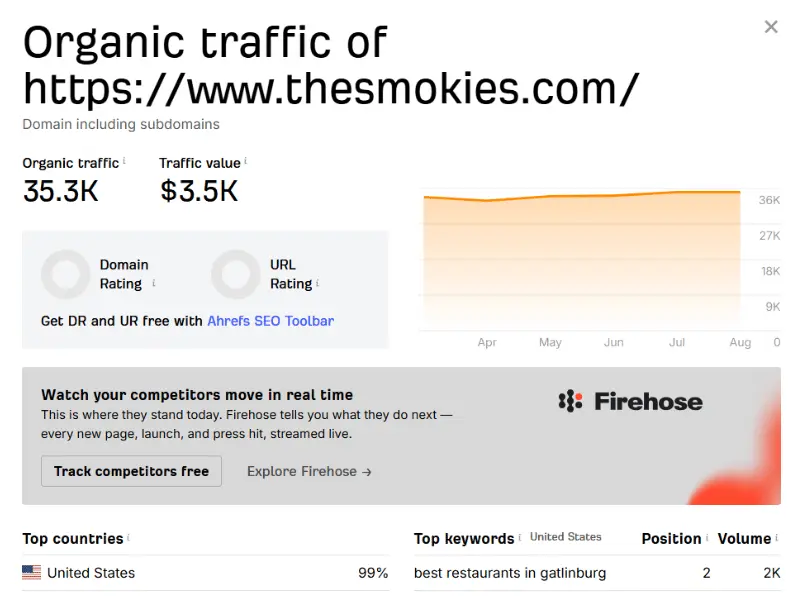
But after the SEO work, organic search became its largest traffic source, accounting for about 50% of traffic, according to Semrush’s case study.
The remaining traffic was approximately:
- 25% direct
- 20% social
- 5% referral
So the site went from being overwhelmingly dependent on social media to having search become its primary traffic channel.
And the change wasn’t only about traffic volume.
The team reported that visitors coming from search were more relevant and more likely to have an intent that matched the site’s content.
SEO Turned the Blog Into a Business
The traffic growth eventually translated into something more important than impressive analytics.
Revenue.
Semrush reported that TheSmokies.com generated more than $200,000 in annual revenue in 2021, less than two years after the site launched.
The founders also used what they learned from the project to launch additional websites.
TheSmokies.com’s own website confirms that the site received more than 1 million pageviews in its first full calendar year and nearly 5 million pageviews in 2022. Today, the company says the site generates around 3–5 million pageviews per year.
So this wasn’t simply a temporary traffic spike.
The project evolved into a real media business.
What Makes This SEO Story So Interesting?
There are plenty of SEO case studies that start with:
“We had a huge website, a large team and a substantial SEO budget.”
TheSmokies.com story is different.
It started as a side project created by people who were learning SEO as they went.
Their first major traffic success didn’t even come from SEO.
It came from social media.
Then they recognized the weakness in their traffic model and deliberately built organic search into the business.
That’s a valuable lesson for smaller websites.
Traffic is not the same as a sustainable traffic strategy.
A website can receive hundreds of thousands of visitors and still be vulnerable if nearly all of those visitors depend on one platform.
Fabina Digital’s Take

What I find most interesting about this story isn’t the $200,000 revenue figure.
It’s the shift in thinking.
The founders didn’t simply celebrate when their traffic exploded.
They asked a more important question:
“Where is this traffic coming from, and can we depend on it?”
That’s a question more website owners should ask.
Social media can be excellent for generating attention quickly. But search can become a valuable long-term acquisition channel when a website consistently answers questions people are already searching for.
Another lesson is that SEO wasn’t treated as a one-time task.
The team worked through technical improvements, keyword research, competitor analysis, content updates, ranking monitoring and link building.
There was no single button that transformed the website.
It was a process of continually improving the website based on what the data showed.
And that’s probably the most realistic way to look at SEO.
What Can Other Websites Learn From TheSmokies.com?
You don’t need to copy TheSmokies.com’s exact strategy.
Instead, take the principles behind it.
Don’t depend entirely on one traffic source
If 90% of your visitors come from one platform, you’re exposed to changes outside your control.
Look for keyword gaps
Your competitors can show you what people are searching for — and where there may still be opportunities to create something better.
Don’t forget your existing content
Some of your best SEO opportunities may already exist on your website.
Before publishing another 50 articles, look at the pages you already have.
Which ones are getting impressions but few clicks?
Which are ranking on page two?
Which have outdated information?
Those pages may deserve attention.
Use data to guide decisions
SEO becomes much more useful when you stop guessing and start measuring.
Track rankings, impressions, clicks, traffic and conversions — then use those signals to decide what to improve next.
Build something worth linking to
TheSmokies.com’s approach also shows the value of original content, useful information and resources that other websites have a reason to reference.
Links shouldn’t be the entire SEO strategy.
But earning relevant links can strengthen a website’s ability to compete.
The Bottom Line
TheSmokies.com didn’t become successful because of one secret SEO trick.
It first found a way to attract attention through social media, recognized that the traffic source wasn’t sustainable, and then built a stronger organic search strategy.
The result was a website that grew from a pandemic-era side project into a substantial family-run media business.
For smaller websites, that’s perhaps the biggest lesson of all:
Don’t just chase traffic. Build a traffic source you can continue to grow.
Sources: Semrush’s case study on TheSmokies.com and TheSmokies.com’s official company/about pages.
Traffic and revenue figures in this article are based on figures reported by the sources above at the time of their respective publications. They should not be interpreted as current traffic or revenue figures for TheSmokies.com.